Three times, Ayrton Senna’s yellow, green and blue helmet lined up on the Suzuka grid with a world championship within reach, and three times he left Japan as champion.
Those titles came in 1988, 1990 and 1991, each decided at the Japanese Grand Prix in October. Only one of them came with a race win. In 1988, he won the race outright. In 1990, he collided with title rival Alain Prost at the first corner, and with both cars out, he won the championship. In 1991, the title was settled when Nigel Mansell went off early, and Senna, leading on the final lap, handed the victory to teammate Gerhard Berger. Between the first and second titles sits 1989, the year Suzuka took a championship away from him, and it explains much of what followed.
Senna’s three titles at a glance
Ayrton Senna clinched every one of his World Championships at Suzuka in October.
-
On 30 October 1988, he won the race in a McLaren MP4/4, beating teammate Alain Prost.
-
On 21 October 1990, he collided with Prost’s Ferrari at Turn 1, settling the title on lap one.
-
On 20 October 1991, he finished second to Gerhard Berger after Nigel Mansell crashed out.
Why Suzuka Kept Deciding the Championship
A Honda test track that became F1’s great decider
Suzuka began as a Honda test facility when Soichiro Honda decided in the late 1950s to build a permanent circuit in Mie Prefecture, and the track opened in September 1962 to a design by the Dutch architect John “Hans” Hugenholtz, with a figure-of-eight layout that carries the back straight over the front section on an overpass. Honda still owns the site. Suzuka first hosted the Japanese Grand Prix in 1987 and has been its main home since, apart from a brief spell at Fuji in 2007 and 2008. McLaren ran Honda engines from 1988 to 1992, so in those years the engine supplier arrived at its own track each October with a driver often in line for the championship.
Soichiro Honda lived to see the first two of those titles. He died on 5 August 1991, days before the Hungarian Grand Prix, which Senna won and dedicated to him. By the time Senna sealed his third championship at Suzuka that October, the man who built the circuit had been gone for ten weeks.
The calendar maths of the late 1980s
In that era, Japan was not the last race of the year. The 1988 Japanese Grand Prix was the fifteenth and penultimate round, and 1990 followed the same pattern with Adelaide closing the season, so a championship could be settled at Suzuka before the teams ever reached Australia. Since 2024, the race has moved to spring, and the 2026 edition ran at Suzuka from 27 to 29 March, which means the circuit no longer sits near the end of the calendar.
A circuit that rewards commitment
The S Curves, Degner, Spoon and the flat-out 130R reward drivers who commit early and give little back to anyone who lifts.
1988 — The Stall, the Comeback and the First Crown
The Setting
McLaren Honda had won 13 of the first 14 races of 1988, and Senna and Prost, teammates and title rivals, locked out the front row at Suzuka. Prost, a Frenchman who had already won two world championships, was also in the final year of the turbo era, with the grid that afternoon split between ten turbocharged cars and sixteen naturally aspirated ones.
Only a driver’s best 11 results counted that year, which put the title in Senna’s hands if he won in either Japan or Australia. Prost finished the season with more points overall, 105 to Senna’s 94, but the dropped scores left Senna ahead, 90 to 87.
The Start That Nearly Ended It
Senna’s Honda V6 stalled as the lights went out. Suzuka had the season’s only sloping grid, and the downhill run let him bump-start the car, but he reached the first corner in 14th place, with Prost already pulling away. Without that slope, he could not have restarted the engine at all.
The Drive
Senna completed the opening lap in eighth place and then, with light rain returning in the early laps, traffic to work through and a gearbox problem on Prost’s car, closed steadily on his teammate, passing him on lap 28 of the 51-lap race in front of the main grandstand and going on to win by just over 13 seconds.
What It Meant
The win gave him his first world championship in his fifth Formula 1 season and made him Brazil’s third world champion after Emerson Fittipaldi and Nelson Piquet, with his eight victories that year setting a new single-season record. The helmet he wore that afternoon is the design at the heart of the Legacy range.

1989 — The Year Suzuka Turned Against Him
Suzuka also decided the 1989 championship in Prost’s favour, and what happened there explains the collision a year later.
Prost led the standings 76 to 60 and was leading the race when Senna tried to pass him on the inside of the chicane on lap 47 of 53, and neither car made the corner. Prost abandoned his stalled car, while Senna got going again with the marshals’ help, rejoined past the chicane, pitted for a new nose and passed Alessandro Nannini to take the checkered flag, only to be disqualified for gaining an advantage by missing the chicane. That handed Nannini the win and Prost the title.
Senna accused FISA and its French president, Jean-Marie Balestre, of rigging the championship for his countryman, and at one point threatened to leave Formula 1 altogether, a grievance he carried into the winter and the following October.
1990 — The Title Decided at the First Corner
Pole On The Wrong Side
Prost, by then a three-time champion, had moved to Ferrari, and Senna led the standings when he took pole at Suzuka. He objected to the side of the track where the pole slot sat, arguing that pole should always be on the racing line, and the stewards initially agreed. Balestre’s injunction that night overturned the decision and left pole on the dirtier, less grippy right-hand side, while Prost qualified second on the clean side.
Turn 1
Prost got the better start, and Senna didn’t lift; as Prost turned in, the McLaren struck the Ferrari and sent both cars off track. Both were out before the first lap was complete, which made Senna champion for the second time.
The Admission
A year later, back at Suzuka, Senna said openly that he had been “determined to get to the corner first”, and he tied that to Balestre’s decision to keep pole on the right. Motor Sport, reporting the outburst in December 1991, called it unworthy of a world champion.
A Title With A Shadow
The result stands in the record books as his second championship, won over a full season, though the collision and his own account of it a year later remain part of how that title is remembered.
1991 — The Title Won With Second Place
A New Rival
Prost was no longer the threat in 1991. Nigel Mansell, runner-up in 1986 and 1987, was driving a Williams-Renault that could beat the McLaren in a straight fight, and although two August wins had put Senna 22 points clear, Mansell still had to win at Suzuka to keep his hopes alive.
Mansell’s Exit
Berger took pole with Senna, and Mansell, running third, hounded Senna until lap 10, when he made a mistake at the first corner and spun into the gravel. With Mansell out, Senna was champion with more than forty laps still to run.
The Gift At The Final Corner
Ron Dennis called Senna on the radio about giving Berger the win, and Senna later said he decided to slow down for his teammate. Coming out of the Casio Triangle chicane for the last time, he eased off and waved Berger through, a thank-you for Berger’s help over the previous two seasons and a gift from the same driver who had refused to lift at Turn 1 a year earlier. It gave McLaren a one-two, and Honda its last one-two finish until the 2019 Brazilian Grand Prix.
Three-Time Champion At 31
Senna, born on 21 March 1960, was 31 when he won his third title in the McLaren MP4/6-Honda, and the fight was closer than the points suggest: with seven rounds to go, Mansell was only eight points behind, and Williams had overtaken McLaren in the constructors’ standings. It remains the most recent Formula 1 World Championship won by a Brazilian driver, and 20 October 2026 is its 35th anniversary.
The racing spirit of those McLaren years runs through the Race Collection.

The Suzuka Scorecard: Three Titles Side by Side
|
1988 |
1990 |
1991 |
|
|
Race date |
30 October |
21 October |
20 October |
|
Car |
McLaren MP4/4-Honda |
McLaren MP4/5B-Honda |
McLaren MP4/6-Honda |
|
Title rival |
Alain Prost (McLaren) |
Alain Prost (Ferrari) |
Nigel Mansell (Williams) |
|
Grid |
Pole |
Pole |
2nd |
|
Senna’s result |
1st |
Retired, lap 1 |
2nd |
|
How it was decided |
Won the race |
Collision with Prost |
Mansell retired |
|
Final points (Senna v rival) |
90 v 87 (counted) |
78 v 71 (counted) |
96 v 72 |
The three columns show three sides of him: relentlessness in 1988, when he recovered from a ruined start, ruthlessness in 1990, at the first corner, and generosity in 1991, when he gave away a win he had already earned.
Why October at Suzuka Still Belongs to Senna
Suzuka was not finished with him after 1991, and in 1993, his final season with McLaren, he won there again, passing Prost on the approach to Spoon as the rain came in.
With the Japanese Grand Prix now run in March, nobody will ever replicate 20, 21 and 30 October at Suzuka, and fans still bring his helmet design to circuits such as Interlagos on replica helmets and shirts. Anyone who came to him through the 2010 documentary Senna or the 2024 Netflix series will find the three Octobers above are the race record behind that story.
Every purchase from Senna Shop supports the Ayrton Senna Institute and funds education projects across Brazil.
Be first to hear about new Senna drops and anniversary releases. Join the newsletter.
Wear the Story
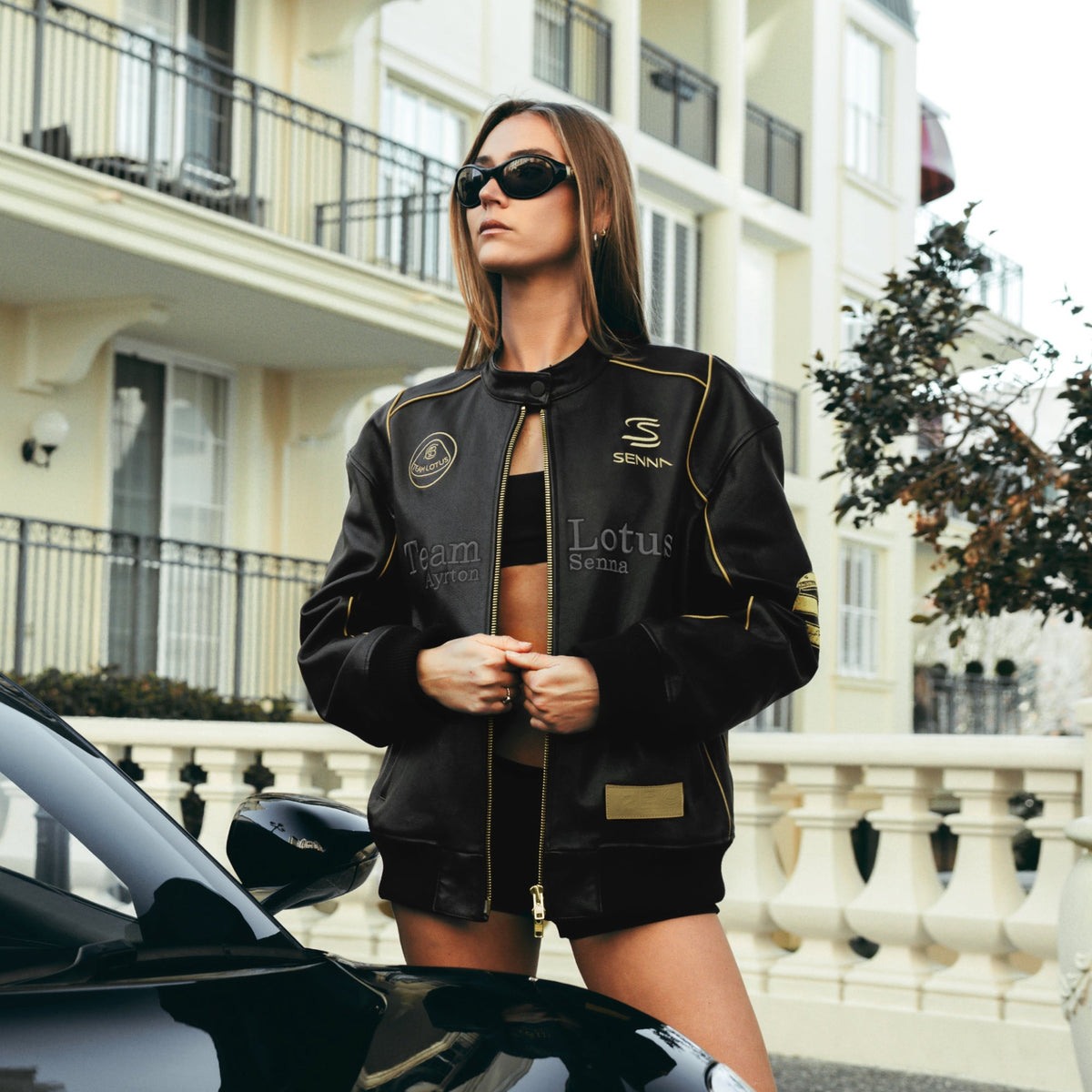
The Senna Helmet Tee and Helmet Zip Hoodie use the design he wore on all three title days, and the story behind that helmet is told in full on the blog. The Senna Race Jacket reflects the racing spirit of the McLaren years, while the Nacional range recalls Banco Nacional, the Brazilian bank that sponsored him through most of his Formula 1 career and whose blue cap became almost as recognisable as his helmet. For everyday wear, the Signature Collection has logo tees, hoodies and crew sweats in black, white and grey.
Carry the Suzuka story with you. Explore the Signature Collection.
FAQs
How many world championships did Ayrton Senna win?
Ayrton Senna won three Formula 1 World Drivers’ Championships in 1988, 1990, and 1991, all with McLaren-Honda. He also took 41 Grand Prix victories and 65 pole positions in a career that ran from 1984 to 1994 with Toleman, Lotus, McLaren, and Williams.
Where did Ayrton Senna win his world titles?
All three were clinched at the Japanese Grand Prix at Suzuka Circuit in Mie Prefecture, Japan, in October: 30 October 1988, 21 October 1990 and 20 October 1991. Japan was the penultimate round in that era, so the title could be settled there before the Adelaide finale.
Did Senna crash into Prost on purpose at Suzuka in 1990?
A year later, Senna acknowledged that he had been determined to reach the first corner ahead of Prost and was not prepared to let him turn in front, and he linked that stance to the ruling that kept his pole position on the dirty side of the grid. The admission drew sharp criticism, including from Motor Sport.
Why did Senna let Berger win at Suzuka in 1991?
Senna had secured the championship when Mansell crashed out on lap 10, and Ron Dennis called him on the radio to ask him to let Berger win as a thank-you for Berger’s help over the previous two seasons. Senna slowed after the final chicane and waved Berger through, finishing 0.344 seconds behind.
Did Senna ever win the Japanese Grand Prix?
Senna won the Japanese Grand Prix twice, in 1988, the race that gave him his first world title, and again in 1993, when he passed Alain Prost on the approach to Spoon Curve in the wet. He won his second in his last season with McLaren, before moving to Williams for 1994.
Why isn’t the Japanese Grand Prix held in October anymore?
Formula 1 moved the Japanese Grand Prix to a spring date from 2024, and the 2026 race ran from 27 to 29 March as the third round of the season, so Suzuka no longer sits near the end of the calendar where championships are decided. October at Suzuka now belongs to Senna's history.